
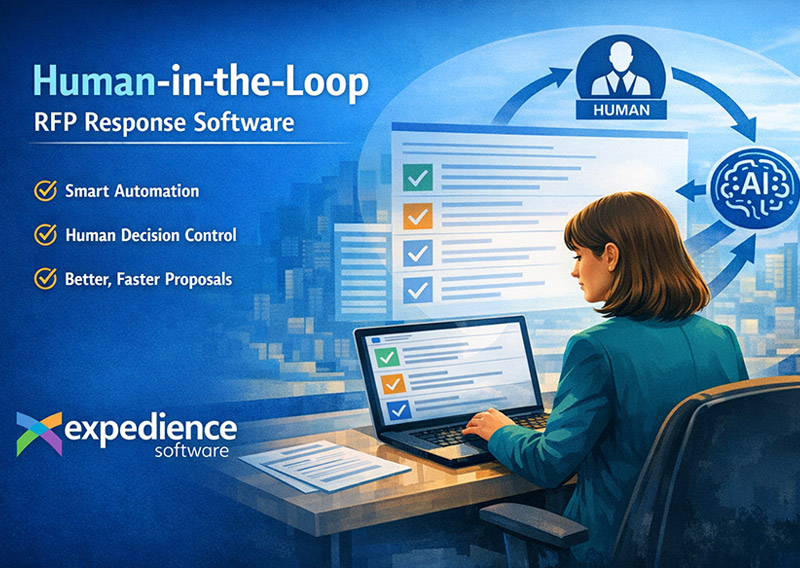
Why Expedience Delivers Faster, More Defensible Proposals Than Auto Responses
As proposal teams adopt AI-powered RFP response software, one design choice matters more than all others:
Who decides the final answer — the system or the human?
Expedience Software was built on a human-in-the-loop RFP response model. Instead of generating automatic answers and hoping they’re right, Expedience uses intelligent automation to recommend, rank, and accelerate response selection — while keeping the user fully accountable for every decision.
The result: faster proposals without sacrificing accuracy, compliance, or trust.
The Expedience Human-in-the-Loop RFP Response Process
Expedience proposal software follows a transparent, step-by-step workflow designed for enterprise and government RFPs.
1. The System Analyzes Question Context
Expedience evaluates each RFP question using:
- Metadata, tags, and structured keywords
- Windows Search, enhanced with Copilot insights
- Question context, not just keyword matching
This ensures the system understands intent, not just phrasing.
2. The System Presents the Most Relevant Pre-Written Content
Rather than generating new text, Expedience surfaces existing, institutional knowledge:
- Curated and approved content blocks
- Ranked by relevance — never forced
- Fully previewable before insertion
This protects accuracy and prevents content drift.
Watch how Expedience analyzes RFP questions and ranks content in real time. Expedience with Copilot AI: Quick, Accurate RFI & RFP Responses
3. The User Chooses the Final Answer
The proposal professional remains in control:
- Select which content to insert
- Edit as needed
- Combine multiple content blocks
- Or write something new entirely
The system accelerates decisions — it does not replace them.
4. Inserted Content Is Native Microsoft Word
All responses are:
- Perfectly pre-formatted
- Fully editable
- Native Word content (no lock-in, no abstraction layer)
Users work inside the tool they already trust — Microsoft Word remains the system of record.
5. The Proposal Document Becomes a Feedback Loop
Every proposal improves the system:
- Tag content for review
- Mark improved answers
- Flag gaps or outdated material
- Promote better responses back into the Portfolio
The document itself feeds continuous improvement.
6. The Core Design Principle: Continuous Improvement
Expedience is not a static content dump.
It creates a living proposal knowledge system that gets stronger with every submission.
Why This Is Superior to Auto-Responses
1. RFPs Are Not Deterministic Problems
Auto-response systems assume:
- Questions are unambiguous
- Context is uniform
- One “best” answer exists
In reality:
- RFP questions are vague, overlapping, and context-dependent
- Subtle wording changes can have legal, pricing, or compliance impact
- The “best” answer depends on strategy, risk tolerance, and deal context
Human judgment is not optional — it’s required.
2. Auto-Responses Create False Confidence
Competitor model:
“The system answered the question.”
Real outcome:
- Users skim instead of thinking
- Errors go unnoticed
- Answers may be technically correct but strategically wrong
- Teams trust output they didn’t consciously choose
Expedience model:
“The system helped me find the right answer — I chose it.”
That difference matters in audits, protests, and post-mortems.
3. Trust Is Higher When Users Decide
Enterprises care deeply about:
- Accountability
- Traceability
- Explainability
With Expedience approach:
- A human can always explain why an answer was used
- The decision path is explicit
- Responsibility is clear
With auto-responses:
- “The system generated it” is not a defensible explanation
This is especially important in:
- Government bids
- Regulated industries
- High-value, high-risk deals
4. Editing Inside Word Is a Feature, Not a Flaw
Many competitors:
- Lock content in proprietary editors
- Discourage editing to “protect the answer”
- Treat deviation as risk
Expedience philosophy:
- Content is meant to evolve
- Word is the workspace professionals already trust
- Editing is how institutional knowledge improves
By allowing:
- In-document editing
- Tagging for later review
- Promotion back into the Portfolio
Expedience turns every proposal into content R&D, not just output.
5. Auto-Responses Break the Content Improvement Loop
Auto-answer systems tend to:
- Generate new text every time
- Obscure which source content was used
- Make it unclear what should be updated
Expedience system:
- Makes source content visible
- Makes gaps obvious
- Encourages deliberate refinement
- Builds a stronger library over time
This leads to higher content quality year over year, not just faster drafts.
6. The Expedience Model Is AI-Compatible — Without Being AI-Dependent
AI can:
- Help analyze the RFP
- Suggest relevant content
- Summarize differences
- Highlight risks
But AI does not:
- Decide the final answer
- Assemble the official response
- Override human judgment
7. Auto-Response Competitors vs Expedience
| Auto-Response Model | Expedience Model |
|---|---|
| System answers | System recommends |
| Black-box logic | Transparent selection |
| High speed, lower trust | High speed and high trust |
| Hard to defend | Easy to explain |
| Content drifts | Content improves |
| AI-dependent | AI-resilient |
Learn More
Transform Business Proposals
More than speed, winning proposals demand accuracy and control. Expedience delivers all three directly within Microsoft Word.
Book a demo to see how!